
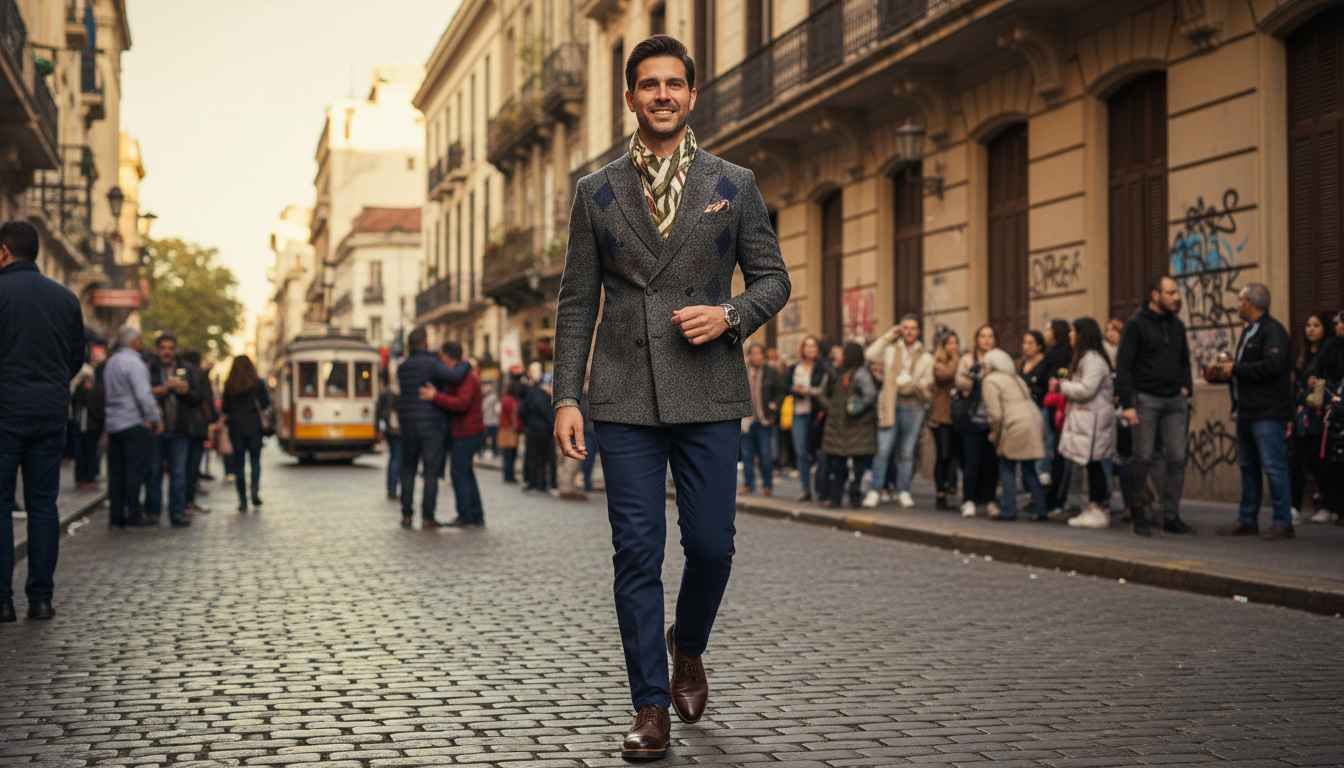
Newton told us that every object persists in its state of motion unless acted upon by an external force. Clothing, too, obeys this law. Left alone, it drifts into habit, tradition, uniform. But apply pressure history, crisis, desire, ego and suddenly fashion accelerates, collides, fractures. Argentina’s style does not float gently through time. It falls. Hard. And each impact leaves a mark on the body and the soul.
To talk about fashion trends in Argentina is to talk about survival dressed as elegance. This is a country where inflation teaches humility faster than any monk, and where clothing becomes philosophy by necessity. When the ground keeps shifting, what you wear is not decoration. It is a statement of balance. Or defiance. Or resignation.
The philosopher knows that style is never just fabric. It is ethics stitched into form. In Argentina, men and women dress as if asking a single question: how do I remain myself when everything else refuses to stay still?
That question has produced one of the most contradictory fashion cultures on the planet. European restraint collides with Latin excess. Tailored wool suits walk beside distressed denim. Leather jackets flirt with political memory. Nothing here is accidental, even when it looks improvised.
Fashion trends in Argentina are not seasonal. They are cyclical, emotional, and occasionally sarcastic. The wardrobe laughs because otherwise it would scream.
The Timeline of Falling Forward
1910–1930: Imported Gravity
Argentina’s early modern fashion borrowed its mass from Europe. Italian tailoring and French silhouettes dominated Buenos Aires, a city convinced it was Paris with better beef. Clothing signaled aspiration. To dress well was to declare allegiance to progress, order, and a future that felt inevitable.
This era still haunts Argentine menswear. The reverence for structure, for jackets that hold their shape against chaos, begins here.
1940–1960: The Weight of the People
Peronism changed the center of mass. Fashion followed politics. Clothes became more practical, more accessible, more symbolic. Workwear entered the mainstream. The suit remained, but its meaning shifted from aristocracy to authority.
Here, clothing learned to speak to power. And sometimes against it.
1970–1989: Disruption and Disguise
Dictatorship forced subtlety. Fashion retreated into coded language. Colors softened. Expression went underground. Leather jackets and denim became quiet rebellion. Style learned how to hide while still communicating.
The philosopher sees this as the era where Argentine fashion mastered irony.
1990–2001: Global Velocity
Neoliberal optimism flooded the market with imports. Logos arrived. Excess returned. Argentine fashion flirted with global sameness, flirting dangerously with forgetting itself.
The crash of 2001 ended that flirtation abruptly.
2002–Present: Creative Resistance
Economic collapse forced invention. Local designers used recycled materials, modular garments, gender-fluid silhouettes. The body became a site of experimentation. Constraint produced creativity, the way gravity produces stars.
Modern fashion trends in Argentina still live here: resourceful, ironic, emotionally literate.
Philosophy Worn Lightly and Heavily at Once
The Argentine wardrobe understands Camus better than most literature departments. Absurdity is not theoretical here. It is lived. And so fashion responds with a wink. Oversized silhouettes coexist with sharp tailoring. Neutral palettes are punctured by sudden color. The outfit says, I know the joke, but I will dress well anyway.
This is why contemporary Argentine menswear favors relaxed structure. Jackets with soft shoulders. Trousers that move. Shirts that do not insist. Comfort becomes a moral position.
Street style in Buenos Aires is a masterclass in contradiction. One sees minimalist sneakers under a perfectly cut coat. Vintage football jerseys styled with pleated trousers. The message is consistent: identity is layered, and coherence is overrated.
It is impossible to understand these choices without understanding scarcity. When choice is limited, intention sharpens. Argentine fashion has learned how to mean something with very little.
For readers who track global menswear through editorial lenses like GQ India, Argentina offers a corrective. It reminds us that style is not born on runways alone. It is forged under pressure.
The Psychology of Dressing After Collapse
There is data behind this intuition. A peer-reviewed study published in the Journal of Consumer Research in 2014 examined how economic instability increases symbolic consumption, finding that individuals in volatile economies use clothing to reassert identity and control. Argentina is practically a living laboratory for this phenomenon.
This explains the persistence of personal style over trend obedience. Argentines follow fashion, yes, but selectively. Trends are interrogated. Modified. Sometimes rejected outright. To dress blindly is considered naive.
This skepticism produces a certain elegance. Not loud. Not submissive. A calm refusal to be dictated to.
Gender, Fluidity, and the Quiet Rebellion
Another defining element of fashion trends in Argentina is the erosion of rigid gender lines. Not through spectacle, but through normalization. Men wear flowing fabrics. Women borrow tailoring. And nobody makes a fuss about it.
This is not activism by megaphone. It is activism by habit. By repetition. By showing up dressed exactly how one wishes, again and again, until the world adjusts.
The philosopher notes that this is how real change happens. Not announced. Lived.
The Satire of Luxury
Luxury in Argentina is treated with suspicion. Designer labels are worn ironically, if at all. Craft matters more than branding. Fit matters more than price. A well-aged leather jacket earns more respect than a pristine logo.
This attitude satirizes global luxury culture. It asks uncomfortable questions. Why pay for excess when skill is local? Why chase novelty when repair tells a better story?
In this sense, Argentine fashion is deeply ethical, even when it pretends not to be.
Potential Drawbacks Who Should Avoid This?
Not everyone will thrive under these conditions. Those who crave predictability, rigid trend cycles, or status-driven dressing may find Argentine fashion frustrating. It does not reward obedience. It does not offer clear rules.
Brands seeking instant scalability often struggle here. Consumers are discerning, skeptical, and emotionally attached to narrative. Fast fashion survives, but it is rarely admired.
There is also the emotional toll. Dressing as self-expression in unstable contexts can be exhausting. When clothing carries meaning, it also carries weight.
The Lesson Beneath the Fabric
Fashion trends in Argentina teach a simple, uncomfortable truth. Style is not about looking good when conditions are ideal. It is about remaining visible when they are not.
Gravity pulls everything down. Argentina learned how to dress on the way.


