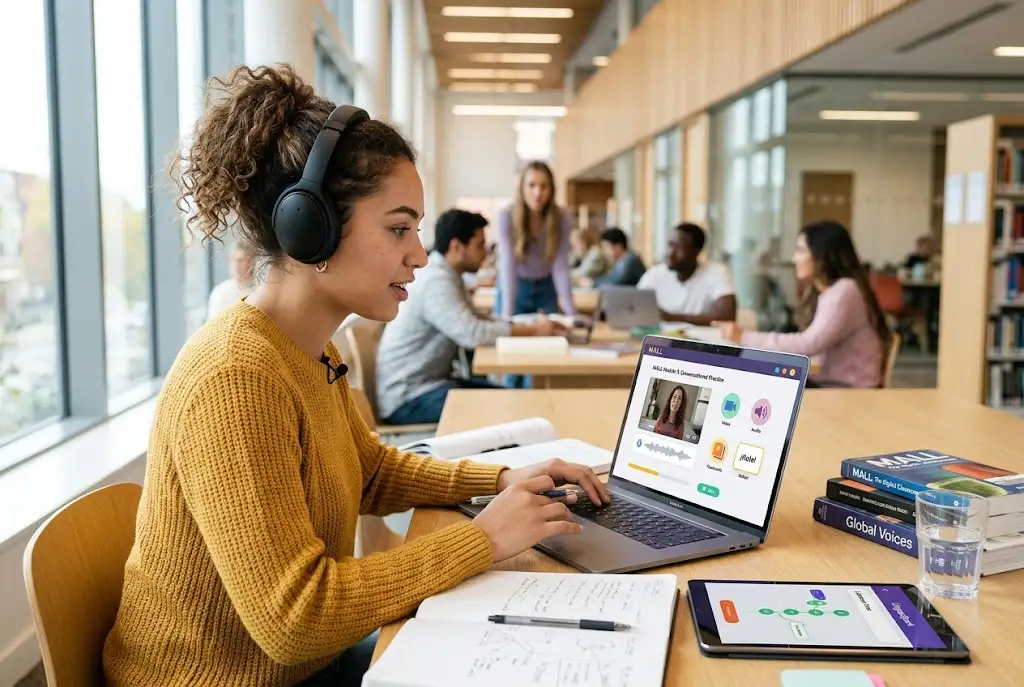
The landscape of modern education is undergoing a massive shift, driven by rapid advancements in educational technology. Traditional textbooks and static grammar drills are no longer the gold standards for achieving fluency. Instead, multimedia-assisted language learning has emerged as a cornerstone of contemporary instruction, blending audio, video, interactive text, and real-time feedback to create immersive educational environments. For students, professionals, and expats navigating an increasingly interconnected world, understanding how to leverage these digital tools is essential for rapid, sustainable language acquisition.
By integrating diverse sensory inputs, technological tools alter how the human brain processes and retains new linguistic structures. This methodology goes far beyond simply moving classroom worksheets onto a computer screen. It fundamentally changes the cognitive load associated with decoding a new tongue, making the path to comprehensive literacy more accessible to diverse cohorts of students.
The Evolution of Technology in Language Learning
To appreciate the impact of modern tools, one must look at how far digital language learning has come. Early educational software was largely linear, relying on basic flashcards and repetitive multiple-choice quizzes. Today, the integration of advanced software ecosystems provides a dynamic space where students interact with authentic media, converse with native speakers virtually, and receive personalized curriculum pathways.
This evolution highlights the expanding role of technology in language learning. Educators now have the capability to create simulated, real-world environments that require active participation. Whether through interactive video modules, branching dialogue trees, or speech-recognition software, technology ensures that input is not just passive, but highly engaging and comprehensible.
Cognitive Benefits of Multimedia-Assisted Language Learning
The primary reason multimedia-assisted language learning yields such impressive results lies in cognitive psychology, specifically Dual Coding Theory. This theory suggests that the human brain processes information through separate visual and verbal channels. When a student encounters a new word accompanied by a relevant image, an audio pronunciation, and contextual text simultaneously, the brain creates stronger, more redundant neural pathways.
This multi-sensory approach yields several distinct operational advantages:
- Enhanced Vocabulary Retention: Associating words with vivid imagery and audio cues makes recall significantly faster compared to rote memorization.
- Improved Contextual Understanding: Video-based modules showcase body language, cultural nuances, and real-world pacing that text alone cannot convey.
- Increased Learner Autonomy: Digital platforms allow individuals to pause, rewind, and repeat complex lessons as often as needed, matching their unique cognitive pacing.
Overcoming Learning Challenges and Structural Barriers
While digital systems offer profound benefits for typical students, they also serve as vital interventions for individuals experiencing specific structural roadblocks. Traditional, text-heavy curricula often inadvertently alienate students who struggle with standard reading mechanics. For instance, an individual dealing with a severe language based learning disability may find the rigid, phonics-heavy focus of standard classrooms overwhelming.
In these scenarios, multimedia-assisted language learning acts as a vital bridge. By reducing the heavy reliance on pure decoding and offering alternative auditory and visual modalities, digital tools mitigate traditional literacy learning difficulties. A student who struggles to parse printed words can leverage text-to-speech features, interactive diagrams, and gamified phonemic awareness exercises to keep pace with their peers, ensuring that physical or neurological variances do not halt academic progression.
The Role of AI and Personalization in Modern Classrooms
The frontier of this educational shift is undeniably driven by intelligent software systems. The rise of sophisticated ai language learning platforms has introduced an unprecedented level of hyper-personalization to the study process. Unlike traditional classrooms where a single teacher must balance the distinct needs of twenty or more students, intelligent algorithms analyze an individual’s inputs in real time.
If a student consistently struggles with irregular verb conjugations or specific pronunciation markers, the platform automatically adjusts subsequent modules to reinforce those weak points. This ensures that online language learning is never a one-size-fits-all experience. It transforms study from a passive chore into an active, adaptive dialogue between the student and the digital interface.
Alternative Frameworks: Gestalt vs. Analytic Processing
Implementing digital tools effectively also requires an understanding of the diverse ways minds naturally process speech. Most conventional systems are designed for analytic language processors—people who learn individual words first and eventually string them together into complex sentences. However, a significant portion of the population relies on gestalt language learning, naturally processing entire phrases or “chunks” of speech before breaking them down into component parts.
Modern multimedia platforms are uniquely equipped to support these natural language learning variations. Through video clips, songs, and situational dialogues, digital tools provide rich, holistic linguistic chunks that satisfy the cognitive needs of a gestalt language learner. By providing contextualized, whole-phrase inputs alongside analytical breakdowns, technology successfully honors diverse natural learning pathways.
Synthesizing Digital Tools with Classic Literature
Embracing modern technology does not mean abandoning classic educational pillars. In fact, the most effective modern methodologies combine advanced software with timeless content. For example, educators are increasingly finding innovative ways of learning language arts through literature by utilizing digital tools to unpack complex classical texts.
Interactive e-books allow students to click on archaic words to instantly view definitions, historical context, or dramatic readings. This integration enriches reading comprehension development, proving that technology does not replace literature; rather, it makes deep literary analysis accessible to a broader, digitally native demographic.
Best Practices for Implementing Digital Language Tools
To maximize the efficacy of multimedia systems, users and academic institutions should adopt a structured framework rather than clicking through apps aimlessly. Successful implementation relies on consistency, strategic variety, and active production.
First, limit daily sessions to manageable intervals—focused, twenty-minute blocks are far more effective for cognitive retention than exhausting multi-hour marathons. Second, vary the media types utilized throughout the week; alternate between podcast-style listening exercises, interactive grammar modules, and video comprehension checks. Finally, ensure that passive consumption is always balanced with active output, using speech-recognition tools or digital writing prompts to solidify theoretical knowledge into functional capability.
Ultimately, multimedia-assisted language learning represents a permanent evolution in global education. By blending cognitive science, intuitive technology, and adaptive formatting, these platforms empower individuals to break down linguistic barriers efficiently, paving the way for a more literate, communicative, and globally connected society.